The Fine Art of Baloney Detection
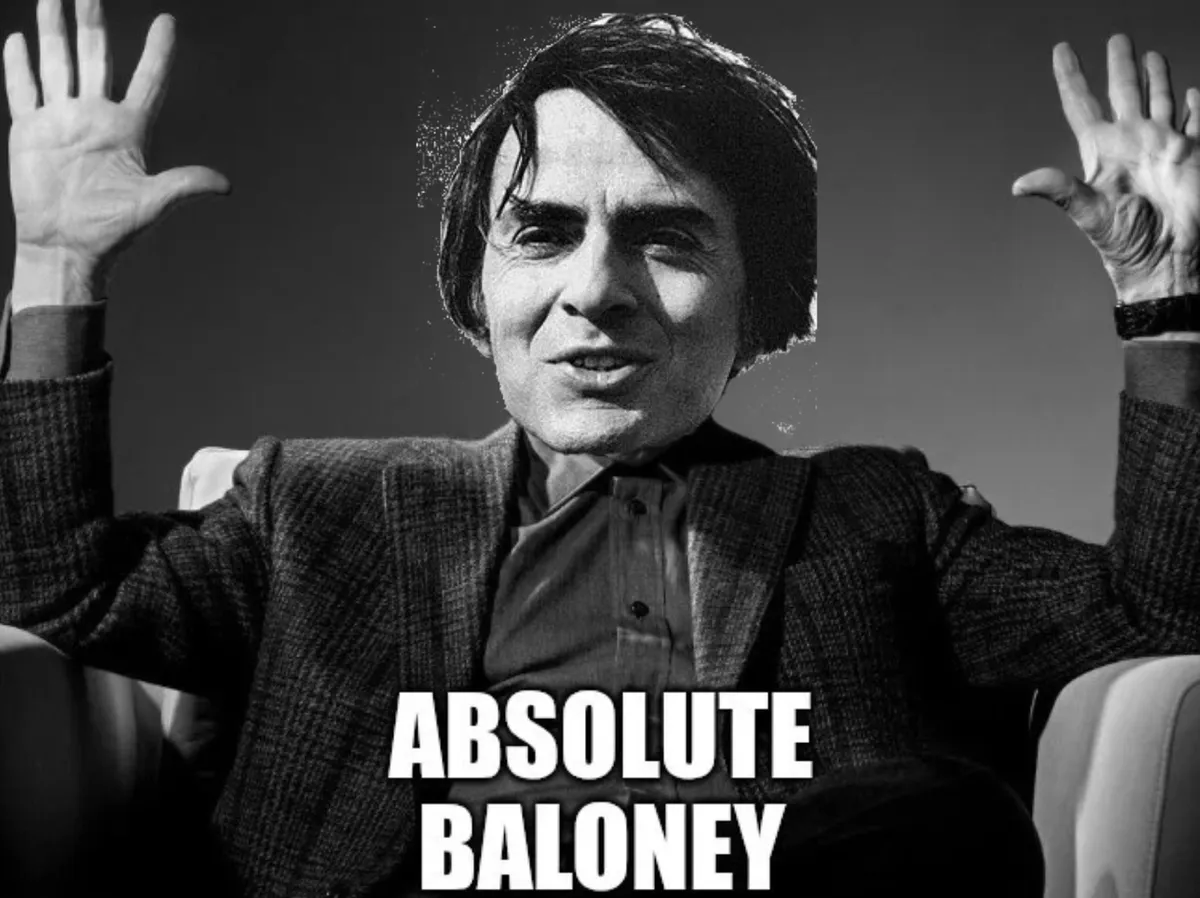
In 1995 Carl Sagan wrote a book named "The Demon-Haunted World" in which he explains how science can be a light in the darkness of a world full of misinformation, lies and deceit.
Given the amount of slop and baloney we now encounter on the daily, I thought it would be worthwhile to explore the book's chapter called "The Fine Art of Baloney Detection".
The Anatomy of Belief and the Baloney Detection Kit
To understand why misinformation is so intoxicating, we have to recognize that human beings are not strictly creatures of cold, hard logic. As Carl Sagan notes at the beginning of the chapter, quoting philosopher Francis Bacon, our understanding is perpetually influenced by our will and affections: "For what a man had rather were true he more readily believes".
Sagan illustrates this vulnerability with disarming honesty through his own grief over the death of his parents. Like anyone who has lost a loved one, a part of him desperately longs to believe in life after death, making him, and all of us, prime targets for wishful thinking, comforting fantasies, and even predatory con artists.
Whether it is communicating with the dead, consulting psychics before making statesmanship decisions, or falling for deceptive commercial advertising, our emotional needs frequently override our critical faculties.
Because our brains are so easily hijacked, we would do well with a scientific and intellectual self-defense mechanism: Sagan's baloney detection kit. Far from being dry academic jargon, these tools for skeptical thinking are practical safeguards designed to help us construct reasoned arguments and spot fraudulent ones.
The kit relies on several core principles for evaluating claims:
Independent Confirmation: Wherever possible, "facts" must be verified by independent sources rather than accepted on blind faith.
Encouraging Substantive Debate: Knowledgeable proponents of all points of view should be allowed to debate the evidence openly.
No Authorities, Only Experts: In science, authority carries little weight; figures who have been right in the past can and do make mistakes, meaning every claim must stand on its own evidence.
Multiple Working Hypotheses: Instead of latching onto the first explanation that appeals to us, we should spin multiple alternative explanations, test them systematically, and let a "Darwinian selection" weed out the weak ones.
Quantification: Vague and qualitative claims are easy to manipulate. Attaching numbers and measures makes competing hypotheses much easier to discriminate.
Every Link Must Work: In a long chain of reasoning, every single link, including the initial premise, must be sound, not just most of them.
Occam’s Razor: When two hypotheses explain the data equally well, the simpler explanation is usually the best choice.
Falsifiability: A valid proposition must be testable in principle. If an idea cannot be disproven or checked against reality, it would be wise to entertain the idea without having to accept it.
Beyond knowing what to do, Sagan emphasizes that a proper detection kit must also teach us what not to do by exposing the most common logical and rhetorical fallacies.
Everyday discourse is riddled with these traps, such as ad hominem attacks (attacking the arguer instead of the argument), arguments from adverse consequences (asserting something must be true simply because the alternative is undesirable), and observational selection (famously described by Bacon as "counting the hits and forgetting the misses").
We also frequently fall victim to post-hoc reasoning (assuming causation simply because two events happened sequentially) and false dichotomies that reduce a spectrum of possibilities down to just two extremes.
Conclusion
Ultimately, the cost of accepting falsehoods extends far beyond harmless amusement or minor financial loss. Whether manifested in pseudoscientific medical scams, deceptive commercial advertising, or corporate campaigns denying lethal public health hazards, the downstream chain reaction of a single unexamined lie can accumulate into unimaginable human suffering. In a world saturated with misinformation, cultivating skepticism is not merely an academic exercise; it is an essential civic and personal safeguard. By insightfully applying the art of baloney detection, we protect not only our own critical faculties but the collective well-being of society against the pervasive darkness of deceit.